How to Make Stairs Safer for an Aging Loved One
Stairs are one of the highest-risk areas in any home. These modifications and strategies can help your loved one navigate them safely.
Stairs are one of the most dangerous areas in any home for older adults. Falls on stairs are more likely to cause serious injuries than falls on flat surfaces, because the person may tumble down multiple steps.
If your loved one uses stairs regularly, here are modifications and strategies that can reduce the risk.
Install Handrails on Both Sides
A handrail on one side is not enough. Install sturdy handrails on both sides of the staircase so your loved one can hold on with both hands. The rails should be:
- ✓Securely anchored to wall studs
- ✓Comfortable to grip, ideally 1.5 inches in diameter
- ✓Extending beyond the top and bottom steps
- ✓At a height of about 34 to 38 inches from the step
If the staircase is wide enough, consider a second rail even if the wall is on only one side. Floor-mounted rails are available for the open side.
Add Non-Slip Treads
Smooth steps are slippery, especially in socks or slippers. Add non-slip treads or strips to each step. Options include:
- ✓Adhesive non-slip strips
- ✓Rubber tread covers
- ✓Carpeted stair treads with non-slip backing
Make sure the treads are securely attached and do not create a new tripping hazard by peeling up at the edges.
Improve Lighting
Stairs must be well-lit. Install bright lighting at both the top and bottom of the staircase. Add light switches at both ends so your loved one does not have to navigate stairs in the dark to reach a switch.
Consider motion-sensor lights that turn on automatically when someone approaches the stairs. These are especially helpful at night.
Mark the Edge of Each Step
Older eyes may have difficulty distinguishing one step from the next, especially if the stairs are a uniform color. Add a contrasting strip of tape or paint to the edge of each step to make them easier to see. Use a color that contrasts clearly with the step surface.
Remove Obstacles
Never store anything on the stairs. Not even temporarily. Items left on stairs are a common cause of falls. Keep the staircase completely clear at all times.
Check the Step Height and Depth
Steps that are unusually high, shallow, or uneven are harder to navigate safely. If the steps are uneven, a contractor may be able to rebuild them. If the steps are too high, a stair lift may be a better option than modifications.
Encourage Proper Footwear
Walking on stairs in socks, slippers, or bare feet is dangerous. Your loved one should wear shoes with non-slip soles when using stairs. If they wear glasses, they should wear them on the stairs.
Consider a Stair Lift
If stairs have become genuinely difficult, even with modifications, a stair lift may be the right solution. A stair lift is a motorized chair that rides along a rail attached to the stairs. It allows your loved one to sit and ride up and down safely.
Stair lifts come in straight and curved models. Straight models are less expensive and work for staircases without turns. Curved models are custom-made for staircases with landings or turns.
A stair lift is a significant investment, but it can allow your loved one to remain in a multi-story home that would otherwise become inaccessible.
When to Move to One Level
If modifications and a stair lift are not enough, or if your loved one has significant mobility or cognitive issues, it may be time to consider moving the bedroom and bathroom to the ground floor. Many single-family homes can be adapted this way, though it may require remodeling.
If a one-level arrangement is not possible and stairs are no longer safe, it may be time to consider moving to a single-story home or an assisted living community. See our article on aging in place versus assisted living for a comparison.
A Caregiver Can Help
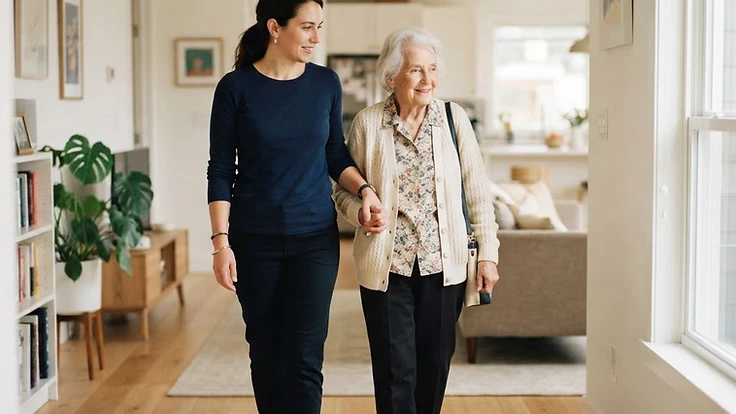
If your loved one needs support on stairs, a caregiver can provide stability and assistance. A caregiver can walk beside them, carry items up and down, and help with transfers. This is especially helpful after a hospital stay or surgery when mobility is temporarily reduced.
For more on home safety, see our room-by-room home safety checklist. And if you would like help assessing your loved one's needs, Healthy at Home offers a free care assessment.
Healthy at Home Caregivers
Educational resource for families and caregivers
Could your loved one use more support at home?
Healthy at Home provides personalized non-medical home care designed around your family's schedule and needs.
Learn About Home CareNeed more support at home?
Every family's situation is different. Healthy at Home can help you understand your options and build a care plan that fits your loved one's needs.
Prefer to talk? Call (949) 340-2617