
Meaningful Activities for Older Adults Living With Dementia
Activities that match your loved one's interests and abilities provide purpose, reduce agitation, and support quality of life.
Boredom is one of the most overlooked challenges in dementia care. When a person with dementia does not have enough to do, they may become restless, agitated, or withdrawn. Meaningful activities provide purpose, reduce behavioral symptoms, and support quality of life.
This article offers activity ideas organized by type and stage of dementia.
Why Activities Matter
According to the National Institute on Aging, engagement and social connection can help maintain cognitive function and improve mood in people with dementia. Activities provide:
- ✓Purpose and meaning. Having something to do gives the day structure and a sense of accomplishment.
- ✓Reduced agitation. Boredom is a major contributor to agitation, pacing, and repetitive behaviors.
- ✓Better sleep. Physical and mental activity during the day promotes better sleep at night.
- ✓Connection. Shared activities provide opportunities for social interaction and relationship-building.
- ✓Preserved abilities. Activities that use existing skills help maintain those skills longer.
Principles for Choosing Activities
Match the Person, Not the Disease
Think about what your loved one enjoyed before dementia. A former gardener may enjoy watering plants. A former teacher may enjoy reading to children. A former cook may enjoy helping with meal preparation.
Focus on Process, Not Outcome
The goal is not to produce a perfect result. It is to provide engagement. If your loved one enjoys folding towels, it does not matter whether they are folded perfectly. The activity itself is the point.
Adjust for Abilities
As dementia progresses, activities need to be simplified. A complex hobby may need to be broken down into simpler steps. The key is to find the level at which your loved one can participate successfully.
Keep It Short
Attention spans may be shorter. Aim for 15 to 30 minutes per activity. Stop before your loved one becomes frustrated or tired.
Be Flexible
Some days will be better than others. If an activity is not working, try something else. Do not force it.
Activities for Early-Stage Dementia
In the early stage, your loved one can often participate in many activities with minimal help:
- ✓Walking or gentle exercise. A daily walk provides physical activity and fresh air.
- ✓Gardening. Watering plants, pulling weeds, or planting seeds. Use raised beds if bending is difficult.
- ✓Cooking and baking. Simple recipes with supervision. Measuring, stirring, and pouring.
- ✓Reading. Books, magazines, or the newspaper. Large print may be helpful.
- ✓Games and puzzles. Card games, board games, jigsaw puzzles with large pieces.
- ✓Music. Listening to favorite music, singing, or playing an instrument.
- ✓Arts and crafts. Drawing, painting, knitting, or coloring. Adult coloring books are popular.
- ✓Social outings. Visiting friends, going to a senior center, or attending a religious service.
Activities for Middle-Stage Dementia
In the middle stage, activities need to be simpler and more structured:
- ✓Folding laundry. Towels, washcloths, and napkins are easy to fold and provide a sense of accomplishment.
- ✓Sorting. Sorting buttons by color, socks by pair, or silverware by type.
- ✓Music and singing. Familiar songs from their youth often bring joy. Music is processed in a part of the brain that dementia affects later.
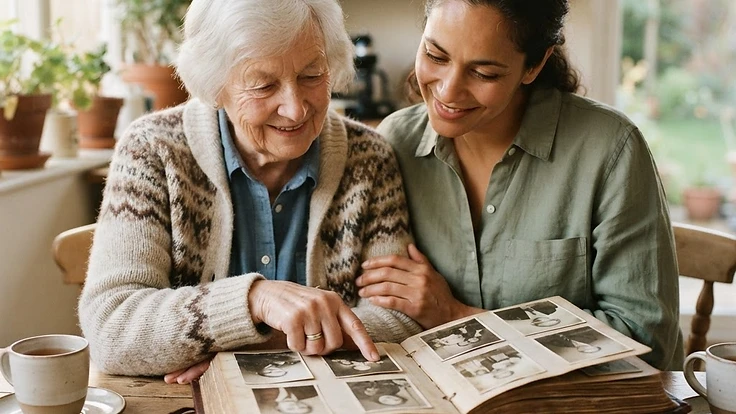
- ✓Looking at photos. Family photo albums, magazines with pictures, or digital photo frames.
- ✓Simple cooking tasks. Washing vegetables, tearing lettuce, or stirring batter.
- ✓Walking. Even a short walk around the block or through the house.
- ✓Pet therapy. If you have a pet, encourage interaction. If not, a visiting pet or a stuffed animal can provide comfort.
- ✓Fidget items. Fidget blankets, busy boards, or sensory items like textured fabrics.
- ✓Simple games. Ball toss, balloon volleyball, or bean bag toss.
Activities for Late-Stage Dementia
In the late stage, activities are primarily sensory and nonverbal:
- ✓Music. Soft, familiar music. Even when speech is lost, music can still reach people.
- ✓Touch. Gentle hand massage, holding hands, or stroking a soft blanket.
- ✓Aromatherapy. Familiar scents like lavender, vanilla, or cinnamon.
- ✓Being read to. A favorite book, poem, or religious passage.
- ✓Looking out the window. Watching birds, trees, or weather.
- ✓Being outside. Even sitting in a garden or on a porch provides sensory stimulation.
- ✓Presence. Sometimes the best activity is simply sitting together quietly.
Activities to Avoid
- ✓Anything that causes frustration. If an activity is too difficult, it will cause distress.
- ✓Activities with many rules. Complex games or tasks may be overwhelming.
- ✓Activities that require good vision or fine motor skills. If these abilities have declined, the activity may be frustrating.
- ✓Activities that could be dangerous. Cooking on a hot stove, using sharp tools, or anything involving water without supervision.
Building Activities Into the Day
Activities work best when they are part of a daily routine. A caregiver can help by:
- ✓Planning activities for the times of day when your loved one is most alert
- ✓Building activities into the routine at consistent times
- ✓Having a few go-to activities ready for restless moments
- ✓Adjusting activities based on how your loved one is feeling that day
For more on routines, see our article on how in-home dementia care supports familiar routines.
The Role of a Caregiver
A caregiver trained in dementia care can:
- ✓Plan and lead activities that match your loved one's interests and abilities
- ✓Provide companionship and social interaction
- ✓Give family caregivers a break while ensuring their loved one is engaged
- ✓Adjust activities as dementia progresses
See our article on when dementia caregivers need more help for more.
The GUIDE Program
If your loved one is enrolled in Medi-Cal and has a dementia diagnosis, the GUIDE program may provide additional support. See our GUIDE dementia care program page for more.
A Final Note
The goal of activities is not to fill time or to prove that your loved one can still do things. It is to provide moments of joy, connection, and purpose. Even a few minutes of engagement can make a difference in your loved one's day.
If you would like help caring for a loved one with dementia, Healthy at Home offers a free care assessment. Our dementia-trained caregivers can help plan and lead meaningful activities.
Healthy at Home Caregivers
Educational resource for families and caregivers
Could your loved one use more support at home?
Healthy at Home provides personalized non-medical home care designed around your family's schedule and needs.
Learn About Home CareNeed more support at home?
Every family's situation is different. Healthy at Home can help you understand your options and build a care plan that fits your loved one's needs.
Prefer to talk? Call (949) 340-2617