
Understanding Dementia: A Guide for Family Caregivers
What dementia is, how it progresses, what it means for daily life, and how families can provide support that preserves dignity and connection.
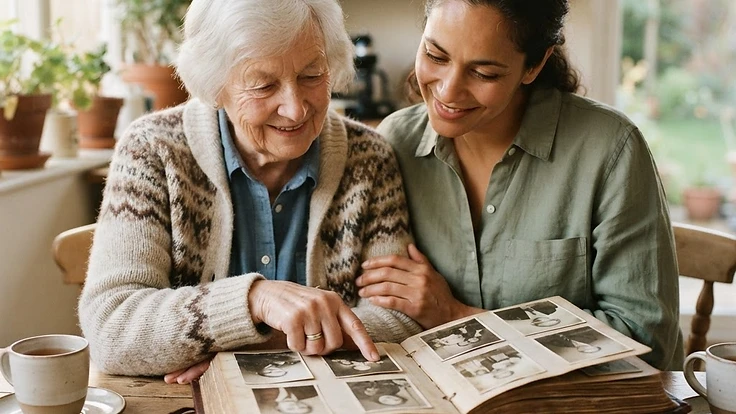
Dementia is a word that families often hear before they fully understand what it means. It is not a single disease. It is a general term for a decline in cognitive function that is severe enough to interfere with daily life. Memory loss is part of it, but dementia also affects thinking, communication, judgment, and behavior.
According to the National Institute on Aging, dementia affects millions of older adults and their families. This guide explains what dementia is, how it progresses, and what families can do to support a loved one living with it.
What Dementia Is
Dementia is not a normal part of aging. It is caused by damage to brain cells, which interferes with their ability to communicate with each other. Different types of dementia affect different parts of the brain, which is why symptoms vary from person to person.
The most common types include:
- ✓Alzheimer's disease: The most common form, accounting for 60 to 80 percent of cases. It typically begins with memory loss and progresses to affect other cognitive functions.
- ✓Vascular dementia: Caused by reduced blood flow to the brain, often after a stroke. It can affect judgment and executive function.
- ✓Lewy body dementia: Associated with abnormal protein deposits in the brain. It can cause sleep disturbances, visual hallucinations, and movement problems.
- ✓Frontotemporal dementia: Affects the frontal and temporal lobes. It often causes personality and behavior changes before memory problems.
For a detailed comparison, see our article on Alzheimer's versus dementia.
How Dementia Progresses
Dementia is progressive, meaning it gets worse over time. The pace varies, but most types follow a general pattern:
Early Stage
In the early stage, changes may be subtle. Your loved one may:
- ✓Forget recent conversations or events
- ✓Misplace items
- ✓Have difficulty finding the right word
- ✓Struggle with familiar tasks like paying bills or cooking
- ✓Become withdrawn or irritable
Many people in the early stage are still largely independent but may need help with complex tasks.
Middle Stage
In the middle stage, which is often the longest, symptoms become more noticeable:
- ✓Increasing confusion about time and place
- ✓Difficulty recognizing friends and extended family
- ✓Needing help with daily activities like bathing and dressing
- ✓Personality changes, agitation, or wandering
- ✓Repetitive questions or behaviors
- ✓Sleep disturbances and sundowning
This is the stage where most families seek additional support, including in-home care.
Late Stage
In the late stage, dementia affects nearly all aspects of functioning:
- ✓Loss of speech or ability to communicate clearly
- ✓Need for round-the-clock care
- ✓Difficulty swallowing and eating
- ✓Loss of mobility
- ✓Vulnerability to infections
Late-stage care often requires a team approach involving family, professional caregivers, and medical providers.
What Dementia Means for Daily Life
Dementia affects more than memory. It changes how your loved one experiences the world:
- ✓Routine becomes essential. Predictable daily routines reduce anxiety and confusion. Changes in schedule or environment can be distressing.
- ✓Communication changes. Your loved one may struggle to find words, follow conversations, or understand instructions. Patience and simple language help.
- ✓Safety becomes a concern. Wandering, leaving the stove on, and falls become real risks as judgment and awareness decline.
- ✓Personality may change. Someone who was always calm may become agitated. Someone who was social may become withdrawn. This is the disease, not the person.
- ✓Independence narrows. Tasks that were once easy become difficult. The goal is to support independence where possible while ensuring safety.
How Families Can Help
Create a Calm, Predictable Environment
- ✓Keep the home organized and free of clutter
- ✓Maintain consistent daily routines
- ✓Reduce noise and visual stimulation
- ✓Keep familiar objects like photos and favorite furniture in place
Communicate With Patience
- ✓Use short, simple sentences
- ✓Ask one question at a time
- ✓Avoid correcting or arguing. Instead, validate and redirect
- ✓Use nonverbal communication: touch, tone of voice, facial expressions
For more detail, see our article on communicating with someone who has dementia.
Focus on Safety
- ✓Secure the home to prevent wandering. See our article on home safety for seniors with dementia
- ✓Remove hazards like loose rugs and clutter
- ✓Lock up medications and sharp objects
- ✓Consider door alarms and GPS devices
Encourage Meaningful Activities
- ✓Activities that match your loved one's interests and abilities provide purpose and reduce agitation
- ✓Music, gardening, folding laundry, and looking at photos are often enjoyable
- ✓Avoid activities that are too complex or frustrating
See our article on meaningful activities for seniors with dementia for ideas.
Take Care of Yourself
Caring for someone with dementia is a marathon, not a sprint. Family caregiver burnout is common and serious. If you are exhausted, you cannot provide good care. See our article on caregiver burnout signs and the benefits of respite care.
When to Seek More Support
As dementia progresses, most families need more help. Signs that it is time include:
- ✓You are not sleeping because of nighttime wandering or anxiety
- ✓Your loved one needs help with most daily activities
- ✓Safety is a concern despite home modifications
- ✓You are experiencing burnout, depression, or health problems
- ✓Your loved one's behavior has become difficult to manage
In-home dementia care can help. Our caregivers are trained in dementia communication, safety strategies, and creating calm routines. See our article on when dementia caregivers need more help for more.
The GUIDE Program
If your loved one has dementia and is enrolled in Medi-Cal, the GUIDE program may provide additional support, including care coordination and caregiver support. See our GUIDE dementia care program page for more.
A Final Note
Dementia changes a person, but it does not erase them. Your loved one is still the person you know, even if they express themselves differently. The goal of care is not to fix what cannot be fixed. It is to preserve dignity, connection, and quality of life for as long as possible.
If you would like help caring for a loved one with dementia, Healthy at Home offers a free care assessment. Our dementia-trained caregivers can help.
Healthy at Home Caregivers
Educational resource for families and caregivers
Could your loved one use more support at home?
Healthy at Home provides personalized non-medical home care designed around your family's schedule and needs.
Learn About Home CareNeed more support at home?
Every family's situation is different. Healthy at Home can help you understand your options and build a care plan that fits your loved one's needs.
Prefer to talk? Call (949) 340-2617